
Top Stories and Alerts

Heads Up: Property Tax Reform FAQs
Updated 8/19/26
Florida Property Tax Reform: What Could It Mean for Coconut Creek?
Florida voters are scheduled to consider Amendment 3 during the November 3, 2026 General Election. If approved, the proposed constitutional amendment would significantly change property taxes for homesteaded and non-homesteaded properties and could substantially reduce property tax revenue received by cities and counties.
The ballot language for Amendment 3 was recently revised following a court ruling that found the original title and summary misleading. Revised ballot language has since been prepared in response to the court's ruling; however, the legal process regarding the ballot language is ongoing. The underlying proposed constitutional amendment itself has not changed. This page will continue to be updated as additional information becomes available.
Why Do Property Taxes Matter?

Property taxes are one of the primary ways cities fund the essential services people rely on every day. In Coconut Creek, these property taxes:
- Keeps you and your family safe by funding police, fire rescue, emergency response, and hurricane or storm preparedness services.
- Maintains the places you use every day like roads, sidewalks, streetlights, parks, playgrounds, and landscaping.
- Supports reliable city services such as trash collection in public areas, code enforcement, senior programs, athletic programs, special events, and customer service when you need assistance.
- Invests in the community’s future through improvements to roads, parks, public buildings, and other projects that protect property values and quality of life.
- Helps keep the City financially prepared so services continue during emergencies, economic uncertainty, or unexpected costs without sudden service disruptions.
The cost of services continues to rise, and cities must still provide important services to the community. To continue funding these vital services, cities may need to find other revenue sources, reduce services, or postpone projects and improvements.
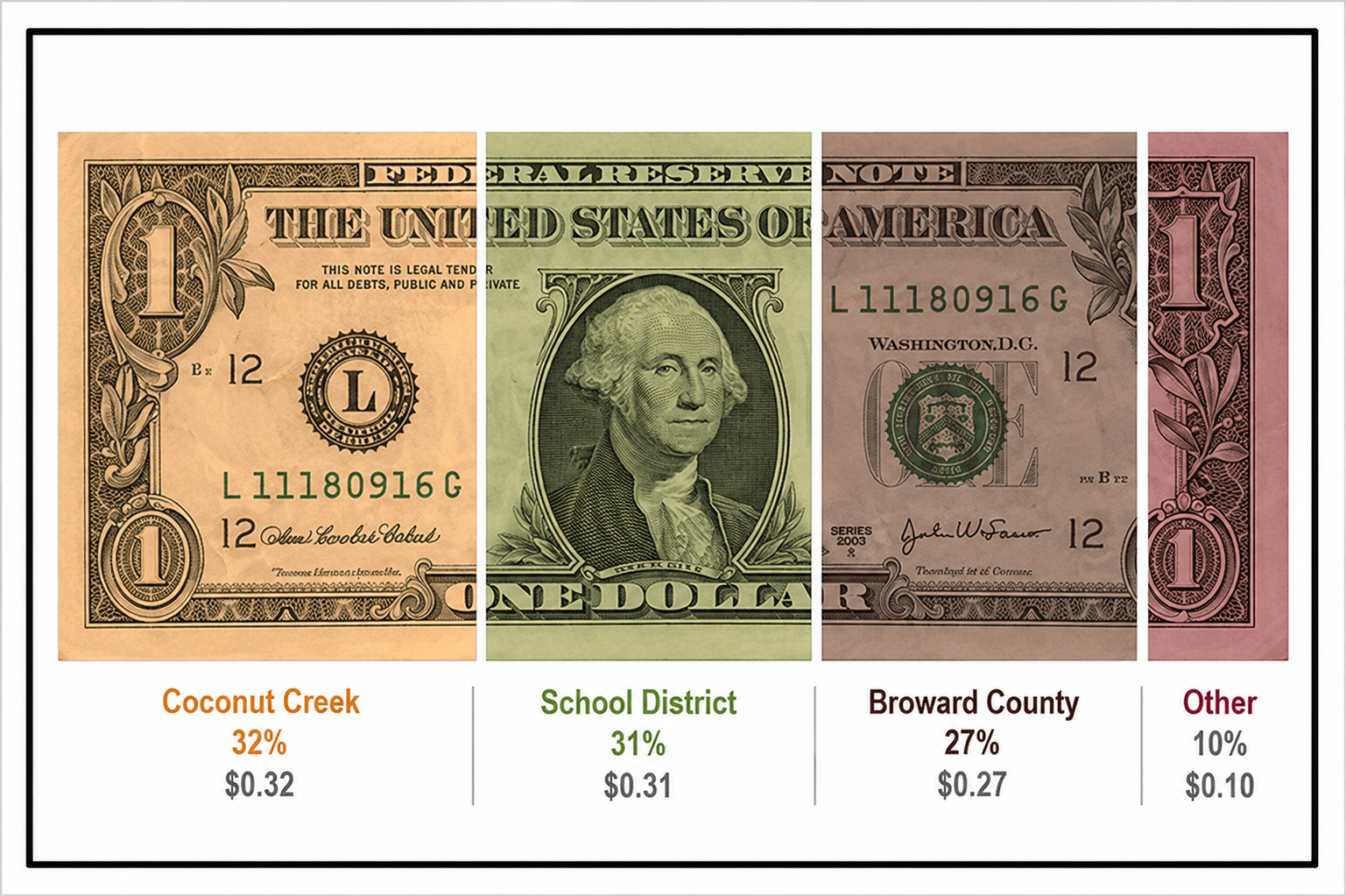
Did you know that the City of Coconut Creek receives only about 32% of your total property tax bill to fund many of the services residents rely on every day, including police and fire protection, emergency response, roads, parks, and other City services?
What Would Amendment 3 Do?
If approved by at least 60% of Florida voters, Amendment 3 would:
- Increase the homestead exemption for non-school property taxes to $150,000 in 2027 and $250,000 in 2028, with inflation adjustments beginning thereafter.
- Reduce the annual cap on assessment increases for non-homesteaded properties from 10% to 5%.
- Require the Legislature to establish a process allowing counties and municipalities to increase the homestead exemption further, up to the property's full assessed value.
- Limit the purposes for which counties and municipalities may use property tax revenue, while providing a process for certain additional expenditures.
- Establish a five-year Florida residency requirement to qualify for the expanded homestead exemption.
What would be the financial impact if Amendment 3 is approved?
If Amendment 3 is approved, Coconut Creek would lose an estimated $6.9 million in 2027, $4.6 million in 2028, and potentially an additional $4.2 million if property taxes is fully eliminated for homesteaded properties.
Homesteaded property owners might see tax savings, but cities would still need to fund essential services, which could result in higher service fees or assessments for everyone.
When property taxes are reduced for one group of property owners, the financial impact may shift to others, such as businesses and rental properties, which can ultimately contribute to higher rents, prices, or other costs.
What Happens If Property Taxes Are Reduced or Eliminated?
The cost of running a city does not disappear when a funding source is reduced. Instead, the pressure shifts. Possible results include:
- Increased taxes for non-homesteaded properties, such as business and rental properties
- Increased fees or special assessments
- Reduced service levels
- Delayed repairs, maintenance, or upgrades
- Slower response to emergencies or storms
- Postponed investments in long-term infrastructure
In everyday terms, residents may experience changes in:
- Police and fire response times
- City maintenance and overall appearance
- Road and infrastructure repairs and improvements
- Hurricane and emergency preparedness and response
- Park and facility upkeep
- Recreation programs, events, and community activities
- Planning for future growth and replacement of aging infrastructure
A Community Conversation
Tax policy is complex, and the impact can reach far beyond a single line on a bill. While tax reductions may appear straightforward, the effects often show up in the services and amenities residents use every day. Our goal is to provide clear, factual information so you can understand what is being discussed and how it may affect Coconut Creek.
As discussions continue in Tallahassee, we will update this page with accurate, easy-to-follow information and resources.
Additional Resources
- Property Tax Virtual Town Hall Meeting (Presented by State Representative Christine Hunschofsky on February 3, 2026)
- Broward County Property Appraiser's Fiscal Impact Estimates
- Florida League of Cities Florida Formula
- Florida Homestead Study Summary of Key Findings
- Full Property Tax Study - Florida League of Cities
Turnpike Expansion
These projects are broken into several different phases and segments, but all have concerning impacts on the City of Coconut Creek. With regard to Turnpike, the project study for the mainline Turnpike is nearing completion and the City's concerns have not been addressed. The Florida Department of Transportation (FDOT) and Florida’s Turnpike Enterprise, held Public Hearings for the Turnpike expansion project for the section from Atlantic to Wiles Road. Staff attended to voice the City’s concerns, and many residents were also in attendance.The project website, Widen Turnpike PD&E, I-595 to Wiles Road Exhibit Room, has a public meeting video and transcripts for the hearings.
The City has major concerns that we have submitted to the Turnpike regarding the mainline Turnpike project. Our concerns include: the Turnpike’s insistence that the road project needs to shift to the west- negatively impacting the South Creek area; the need for ten lanes when traffic volumes only warrant an 8-lane cross-section; the placement and height of the noise walls; and non-receipt of the amended plans from the Turnpike. The City has tried to seek commitments from the Turnpike related to these important issues, to no avail, so the City filed a lawsuit in Circuit Court in August, 2025. Please continue to stay involved and share your concerns as we continue to challenge the expansion and develop a plan of action.
People wishing to submit written or verbal comments/questions please contact the project development engineer, Rax Jung, P.E., Ph. D., via email at Rax.Jung@dot.state.fl.us or by phone at (407) 264-3870.